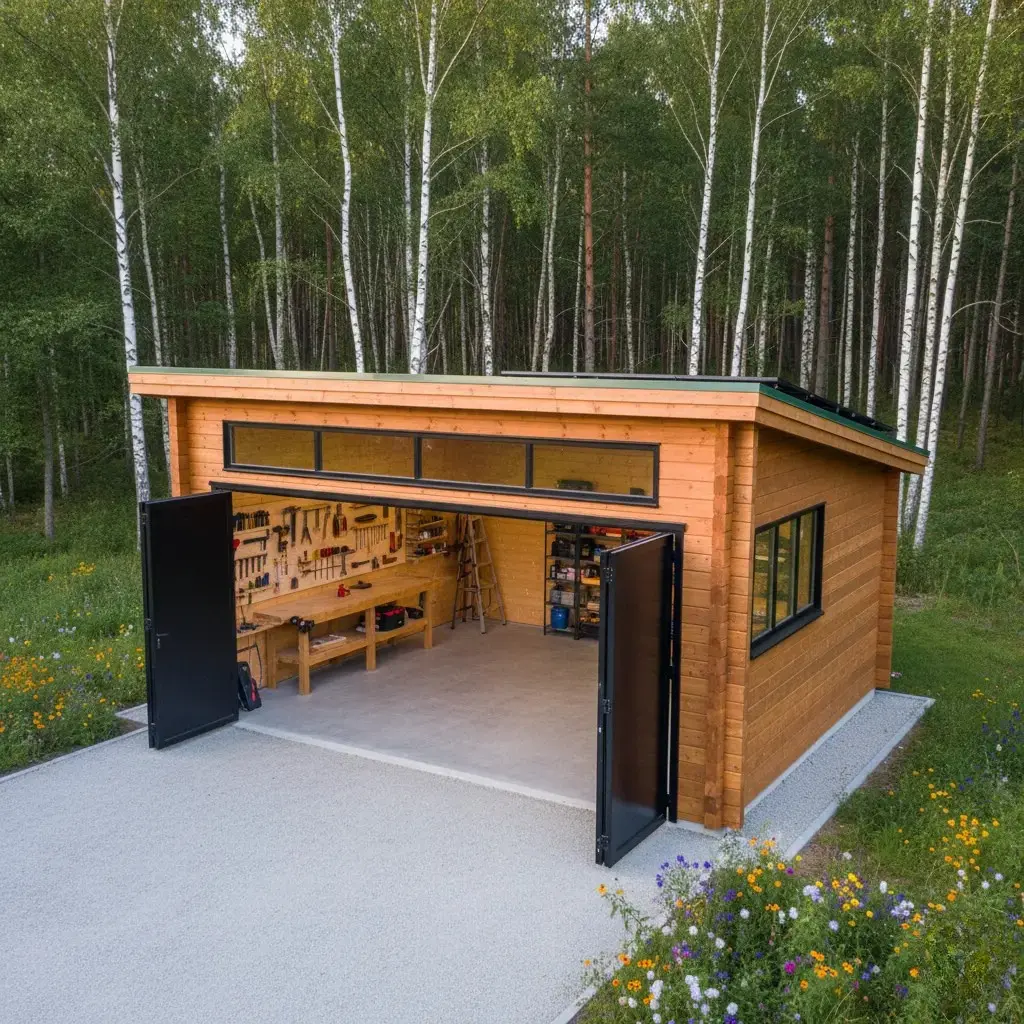
Bespoke Timber Garages & Workshops — London & Cambridge
A great garage or workshop does more than shelter a car or tools — it protects, organises and makes practical work enjoyable all year round.
At Chisel to Wood, we design and build bespoke timber garages and workshops across Greater London and Cambridge, from neat single bays with storage to multi-bay garages with integrated benches, power, lighting and insulation for comfortable use in every season.
Each building is tailored to your plot, access, vehicles and hobbies, then detailed for long-term durability and low maintenance.
What we build (mix, match, and scale)
Single Bay Garages: space-efficient footprints with smart storage, personnel door, lighting scenes and weather-tight thresholds.
Double & Multi-Bay Garages: clear spans for larger vehicles, classic twin doors or single wide opening, concealed gutters and tidy eaves.
Insulated Workshops: year-round comfort for woodworking, bike builds or studio use; acoustic upgrades where neighbours are close.
London projects (access, neighbours, conservation)
Building in London means tight access, close neighbours and high expectations.
We regularly work in Richmond, Wimbledon, Chiswick, Hammersmith & Fulham, Hampstead, Camden, Islington and Chelsea, planning street-front deliveries, protecting routes and sequencing works to keep disruption low.
Designs consider overlooking, acoustic breakout and night lighting from day one. In conservation areas or near listed buildings, we use calm forms and warm timber cladding that read as craft, not pastiche — and we’re comfortable supporting planning dialogue with clear drawings and material samples.
In Cambridge city and villages such as Histon, Girton, Trumpington, Shelford and Sawston, clients often prioritise robust performance with quiet aesthetics.
We deliver breathable fabric build-ups, standing-seam effect roofs, and claddings (larch, cedar, Thermowood or charred timber) that weather beautifully.
Workshops are tuned for draught control, task lighting, dust extraction provision and tool-friendly power — so the space stays useful, tidy and comfortable.
Hose points and washable wall panels in wet zones.
Compressed air and power outlets positioned where you actually work.
Lighting angles that reveal swirls for detailing without glare.
EV conduit pre-runs and consumer-unit capacity ready for your charger installer.
Planning & permissions (plain-English)
Garages and workshops can fall under Permitted Development or require planning permission depending on height, position, use and context.
We’ll review your site and give a straightforward route:
PD basics: overall height, eaves height and boundary offsets are the big three; detached vs. attached matters.
Conservation/listed: expect design sensitivity; we supply clear elevations/sections, material samples and lighting notes.
Building Regulations: attached structures, proximity to boundaries, door fire performance and electrics can bring Regs into scope; we coordinate with independent inspectors so compliance is tidy and predictable.
London: Richmond, Wimbledon, Chiswick, Hammersmith, Fulham, Hampstead, Camden, Islington, Chelsea and neighbouring districts.
Cambridge & villages: Cambridge city, Histon, Girton, Trumpington, Shelford, Sawston and surrounding areas.
Slightly outside?
Ask — if access and programme make sense, we’re flexible.
FAQs – London & Cambridge Garages & Workshops
Can you match doors to an existing house style?
Yes. From modern aluminium sectional doors to timber side-hinged sets with traditional proportions, we’ll propose options that sit comfortably with your elevation.
Will it be warm enough to work in winter?
If you choose an insulated workshop spec, absolutely. We design for insulation continuity, draught control and right-sized heating so comfort is stable.
Can you integrate dust extraction and compressed air?
Yes — we’ll plan duct routes, isolation switches and hose points, and leave access for future upgrades.
Do I need planning permission?
Sometimes. It depends on size, height, position and context. We’ll advise the cleanest route and, if needed, handle drawings and submissions.
What’s the typical on-site duration?
After design and procurement, most single bays and compact workshops are 1–2 weeks on site; larger/multi-bay projects run longer. Prefabricated sub-assemblies can shorten time and reduce noise.